Products
Quinclorac 25% SC Herbicide – Selective Post-Emergence Control for Grasses & Broadleaf Weeds
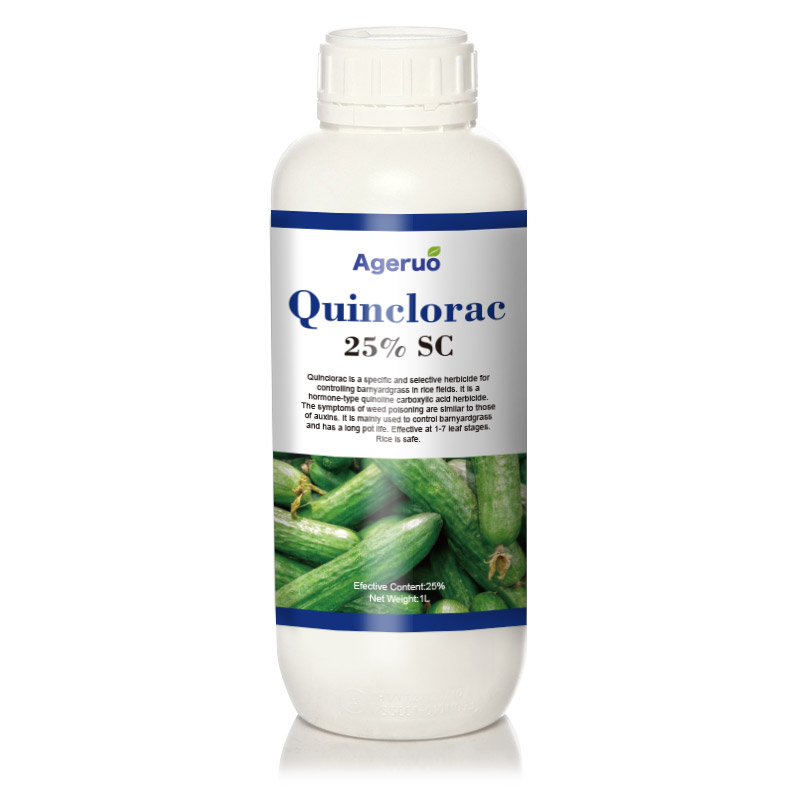


Introduction
| Parameter | Specification* |
|---|---|
| Product name | Quinclorac 25% SC |
| Active ingredient | Quinclorac 25% w/v (250 g/L) |
| Chemical family | Synthetic auxin herbicide (growth regulator) |
| CAS No. | 84087-01-4 |
| Formulation type | SC – suspension concentrate |
| Appearance | Off-white to light beige liquid suspension |
| Density (approx.) | ~1.05–1.10 g/mL (typical range) |
| pH range | Typically 4.0–7.0 (formulation dependent) |
| Suspensibility | Meets standard SC suspensibility requirements |
| Target use | Selective post-emergence herbicide for grasses & some broadleaf weeds |
| Typical pack sizes | 100 mL, 250 mL, 500 mL, 1 L, 5 L (bulk options available) |
| Shelf life | Normally 2 years in original, unopened container |
| Quality documents | COA, MSDS, TDS; further analytical data on request |
Quinclorac is a synthetic auxin-type herbicide (growth regulator) with activity against several annual grasses and some broadleaf weeds, especially barnyardgrass in rice systems. The 25% SC formulation is a liquid suspension of finely milled quinclorac particles in water with dispersing and wetting agents, designed to be diluted in water and applied with standard sprayers.
Key characteristics of quinclorac 25 SC herbicide:
-
Active ingredient: Quinclorac 25% w/v (250 g/L)
-
Formulation type: SC – suspension concentrate
-
Use pattern: Selective, mostly post-emergence in rice, cereals and turf
-
Target: Problem grasses (e.g. barnyardgrass) and some broadleaf weeds, depending on label
For buyers who want to buy quinclorac in a modern, user-friendly formulation, quinclorac 25% SC is an ideal option to position in professional crop and turf portfolios.
Mode of Action
Quinclorac acid belongs to quinoline carboxylic acid herbicide. Quinclorac is a selective herbicide used to control barnyard grass in rice fields. It belongs to hormone type quinoline carboxylic acid herbicide and is a synthetic hormone inhibitor. The medicament can be quickly absorbed by the germinating seeds, roots, stems and leaves, and rapidly transmitted to the stems and tops, causing weeds to die of poisoning, similar to the symptoms of auxin substances. It can effectively control barnyard grass in direct seeding field, and has good control effect on barnyard grass in 3-5 leaf period.
Role in sensitive grass weeds
In sensitive grass weeds (e.g. barnyardgrass, big dogwood, broadleaf signalgrass, and green dogwood), Quinclorac causes accumulation of tissue cyanide, inhibits root and shoot growth, and causes tissue discoloration and necrosis.
Weed Spectrum – Target Weeds
The quinclorac weed spectrum focuses mainly on difficult grass weeds, and in some registrations, certain broadleaf species. Depending on the country label, quinclorac 25% SC may control or suppress:
-
Grass weeds (key focus)
-
Barnyardgrass (Echinochloa spp.) – primary target in rice
-
Some other annual grasses (e.g. crabgrass, foxtail) where labelled
-
-
Broadleaf weeds (label-dependent)
-
Certain small-seeded broadleaf species
-
Some sedges or mixed weed populations in rice or turf (where authorised)
-
The exact weed list, growth stages and control spectrum must follow your national registration and product label. As a selective herbicide, correct timing and application conditions are critical for performance and crop safety.
Act on these Pests:

Crop Uses
Without specifying application rates or spray intervals, typical professional uses of quinclorac 25% SC herbicide include, where registered:
Rice (Primary Market)
Quinclorac for rice is one of the most important market segments worldwide. In many rice systems, barnyardgrass and mixed grass–broadleaf infestations reduce yield and complicate water management. Quinclorac 25% SC is often used as a post-emergence herbicide in transplanted or direct-seeded rice, when weeds and crop are at appropriate stages as defined by the label.
Other Cereals & Grains
In some countries, quinclorac 25% SC may be registered for use in additional cereals or grain crops (subject to local regulations), targeting similar annual grass complexes and certain broadleaf weeds. The exact crop range depends on national labels.
Turf, Lawn and Amenity Grass
Quinclorac herbicide is also used in turf and lawn management (golf courses, sports fields, parks) to manage problem grasses and mixed weed populations where selectivity permits. The SC formulation supports uniform coverage and ease of use for professional turf managers.
Always check the approved crop list, timing and restrictions on your local product label before positioning quinclorac for sale in any specific segment.
Suitable crops:

Using Method
|
Formulations |
Crop names |
Weeds |
Dosage |
usage method |
|
25% WP |
Rice field |
Barnyardgrass |
900-1500g/ha |
Stem and leaf spray |
|
50% WP |
Rice field |
Barnyardgrass |
450-750g/ha |
Stem and leaf spray |
|
75% WP |
Rice field |
Barnyardgrass |
300-450g/ha |
Stem and leaf spray |
|
25% SC |
Rice field |
Barnyardgrass |
1050-1500ml/ha |
Stem and leaf spray |
|
30% SC |
Rice field |
Barnyardgrass |
675-1275ml/ha |
Stem and leaf spray |
|
50% WDG |
Rice field |
Barnyardgrass |
450-750g/ha |
Stem and leaf spray |
|
75% WDG |
Rice field |
Barnyardgrass |
450-600g/ha |
Stem and leaf spray |
|
Rape field |
Annual grass weeds |
105-195g/ha |
Stem and leaf spray |
|
|
50% SP |
Rice field |
Barnyardgrass |
450-750g/ha |
Stem and leaf spray |
Effectiveness against barnyard grass
Quinclorac is effective against barnyardgrass in rice paddies. It has a long application period and is effective from the 1-7 leaf stage.
Control of other weeds
Quinclorac is also effective in controlling weeds such as raindrops, field lily, watercress, duckweed, soapwort and so on.
Common Formulations
Common dosage forms of Quinclorac include 25%, 50%, and 75% wettable powder, 50% soluble powder, 50% water-dispersible granule, 25% and 30% suspension, and 25% effervescent granule.
Soil Residues
Residues of Quinclorac in soil are mainly through photolysis and degradation by microorganisms in the soil.
Crop Sensitivity
Certain crops such as sugar beets, eggplants, tobacco, tomatoes, carrots, etc. are very sensitive to Quinclorac and should not be planted in the field the following year after application, but only after two years. In addition, celery, parsley, carrots and other umbelliferous crops are also very sensitive to it.
Getting the right application period and dosage
In the rice-planting field, barnyard grass 1-7 leaf period can be applied, but need to pay attention to the amount of active ingredient mu, the water will be drained before the drug, the drug after the release of water back to the field and maintain a certain water layer. The direct field needs to be applied after the seedling 2.5 leaf stage.
Adopt the correct application technique
Spray evenly, avoid heavy spraying, and make sure the amount of water is sufficient.
Pay attention to weather conditions
Avoid high temperature during spraying or rain after spraying, which may cause flooding over the heart of the seedlings.
Symptoms of drug damage
In case of drug damage, the typical symptoms of rice are onion heart seedling (the heart leaves are rolled longitudinally and fused into onion tubes, and the tips of the leaves can be unfolded), the new leaves can not be extracted, and the new leaves can be seen rolled inward when peeling off the stalks.
Treatment measures
For the paddy fields that have been affected by the drug, measures can be taken in time to promote the recovery of seedling growth by spreading compound zinc fertilizer, spraying foliar fertilizer or plant growth regulator.
FAQ
How do you guarantee the quality?
Formulation Advantages
The 25% SC (suspension concentrate) formulation provides multiple practical and commercial benefits:
-
Easy handling and mixing – liquid product that disperses readily in water under agitation.
-
Good stability and suspensibility – designed to remain uniform during storage and application when correctly handled.
-
Uniform spray coverage – fine, well-dispersed particles contribute to consistent coverage on weed foliage.
-
Lower odour and lower solvent content compared with some EC formulations.
-
Flexible OEM small packs – SC is well suited for 100 mL–5 L retail and professional packs, making it easy to market under your own brand.
For distributors and brand owners, these SC formulation advantages make quinclorac 25% SC a strong choice to promote in both rice and turf segments.
Packaging & OEM
We offer quinclorac 25% SC for sale in a wide range of packaging and branding configurations to match different sales channels and markets.
Typical packaging options:
-
Retail & professional packs:
-
100 mL, 250 mL, 500 mL, 1 L, 5 L HDPE or COEX bottles
-
-
Bulk formats:
-
20 L, 200 L drums or IBCs for local repacking or large programs
-
OEM / private label capabilities:
-
Custom brand name, logo and label design
-
Multi-language labels (e.g. English, French, Spanish, Portuguese, Russian, Arabic and others)
-
Regulatory text layout based on your registration requirements
-
Carton design tailored for shelves and shipping efficiency
If you are comparing quinclorac suppliers and looking for a partner who can support both quality and brand building, our OEM services are structured to help you launch or upgrade your quinclorac 25% SC herbicide line efficiently.
Quality Control
To support registrations, tenders and key customer audits, we provide a full technical and quality package for quinclorac 25% SC:
-
COA (Certificate of Analysis) for each batch with active content and key parameters
-
MSDS (Material Safety Data Sheet) in English and other languages as agreed
-
TDS (Technical Data Sheet) summarising formulation properties and typical physico-chemical data
-
Additional analytical, impurity or stability information can be discussed for specific projects
Production follows defined QC protocols, from raw-material qualification through in-process checks to finished-product verification, helping ensure batch-to-batch consistency for your market.
Storage, Handling & Compliance
-
Professional use only: Quinclorac 25% SC is a professional crop protection herbicide and should be used by trained operators in accordance with the label and local regulations.
-
Storage: Keep in the original, tightly closed container in a cool, dry and well-ventilated warehouse, away from direct sunlight, extreme temperatures and incompatible materials.
-
Handling: Use appropriate personal protective equipment and follow the safety recommendations in the product label and MSDS.
-
Regulatory compliance: Always respect national herbicide regulations, including registered crops, weeds, timing, buffer zones, re-entry intervals and environmental protection measures.
This page is intended for product and procurement information and does not replace the official label or national regulatory documents.
Ordering Guide
For B2B buyers, quinclorac 25% SC for sale is structured around practical order volumes, documentation and logistics:
-
MOQ (Minimum Order Quantity)
-
Typically one production batch or a practical pallet/container quantity of your selected pack sizes. Mixed-product containers can be discussed depending on your product range.
-
-
Lead time
-
Usually about 20–30 days after order confirmation and approval of OEM artwork (if applicable), subject to production schedule and vessel availability.
-
-
Documents provided
-
COA, MSDS, TDS and standard shipping documents. Additional technical data can be discussed for registration files or tender submissions.
-
-
Pricing
-
Quinclorac 25 SC price depends on active content, pack size, total volume, documentation requirements and destination port. We prepare quotations case by case to give you a realistic landed-cost picture for your market.
-
To obtain a detailed offer, you can share:
-
Required pack sizes and branding concept
-
Destination country and port
-
Expected first order and annual forecast
-
Any special regulatory or tender requirements
This allows us to design a supply and pricing plan that fits your positioning and competitiveness goals in the quinclorac herbicide segment.
FAQ
1. What weeds does quinclorac 25% SC control?
Quinclorac 25% SC is mainly used against barnyardgrass and other annual grass weeds in rice and, in some labels, certain broadleaf weeds and mixed infestations. The exact quinclorac weed spectrum depends on your national registration and product label.
2. Is quinclorac a selective herbicide?
Yes. Quinclorac selective herbicide is designed to control sensitive weeds while preserving tolerant crops such as rice or certain turf species, when used at the correct rates and timings according to the label.
3. Is quinclorac used pre-emergence or post-emergence?
Most labels position quinclorac 25% SC as a post-emergence herbicide, applied after crop and/or weeds have emerged, at defined growth stages. Specific timing and conditions must follow your local label and agronomic guidance.
4. What pack sizes are available for quinclorac 25% SC?
We can supply quinclorac 25% SC in 100 mL, 250 mL, 500 mL, 1 L and 5 L bottles, as well as bulk drums and IBCs. Other sizes may be developed based on your market needs and OEM project.
5. Do you provide COA, MSDS and TDS for quinclorac 25% SC?
Yes. Every shipment includes COA, MSDS and TDS. Additional analytical or stability data can be discussed for registration, tender or key-account requirements.
6. What factors influence quinclorac 25 SC price?
Quinclorac 25 SC price is primarily influenced by order volume, packaging type, document needs, destination port and shipping conditions. Combining quinclorac with other products in a mixed container can also improve logistics efficiency and cost.
7. Can I order OEM / private-label quinclorac 25% SC?
Yes. We offer full OEM / private-label services so you can market quinclorac 25% SC for sale under your own brand. We support label and carton design, multi-language layouts and pack size selection to match your target channels.
8. Can you ship mixed containers with other herbicides or pesticides?
In many cases, we can load quinclorac 25% SC together with other herbicides, insecticides, fungicides or formulations in one container, subject to product compatibility and DG/packing rules. This helps optimise freight cost and inventory planning.
Why Choose US
If you are building or expanding your rice herbicide or turf weed control portfolio, partnering with a dependable quinclorac manufacturer is essential.
We combine:
-
Stable quinclorac 25% SC formulation
-
OEM and multi-language packaging
-
Full documentation support (COA/MSDS/TDS)
-
Export experience across Asia, Africa, the Middle East and Latin America
Share your specification, destination and volume plan, and we will prepare a tailored proposal to help you position quinclorac 25% SC herbicide competitively in your local market.